How to Play the G Chord Guitar: Beginner’s Step-by-Step Guide
Hey there, aspiring guitarist! Have you ever picked up your guitar, excited to strum along to your favorite tunes, only to get stuck on that tricky G chord? You’re not alone. The G chord on guitar is one of the first hurdles many beginners face, but it’s also a gateway to playing tons of amazing songs.
Whether you’re just starting out or brushing up on basics, this guide will walk you through everything you need to know about the G chord guitar style. We’ll cover finger placements, tips to make it sound clean, variations for different sounds, and even some real-life examples from popular music. By the end, you’ll be switching to the G major chord like it’s second nature. Let’s dive in!
What Is the G Chord and Why Should You Learn It?
Picture this: You’re sitting around a campfire, guitar in hand, and everyone wants to sing along to classics like “Wonderwall” or “Sweet Home Alabama.” What’s the common thread? The G chord. In simple terms, the G major chord is made up of three notes: G, B, and D. These come from the G major scale, which is one of the most friendly keys for guitar players because it fits nicely on the fretboard.
Why bother learning it? Well, the G chord is a foundational open chord, meaning you play it without barring all strings. It’s used in countless genres, from folk to rock to country. According to music theory basics, it’s the “I” chord in the key of G, making it a starting point for progressions like G-C-D, which show up in over 40% of popular songs. As someone who’s jammed with friends for years, I can tell you it’s rewarding—once you nail it, songs flow easier, and your confidence skyrockets. Plus, it’s versatile; you can tweak it for different vibes without fancy equipment.
But here’s a quick disclaimer: If you have hand issues like arthritis, consult a doctor before pushing too hard. Guitar should be fun, not painful!
Step-by-Step: How to Play the Basic G Chord on Guitar
Alright, let’s get hands-on. The standard open G chord is super beginner-friendly and only needs three fingers. Grab your guitar, tune it up (use an app if you’re new), and follow along. We’ll use the most common fingering, but remember, there’s no “one right way”—it’s about what feels comfortable for you.
Here’s the breakdown:
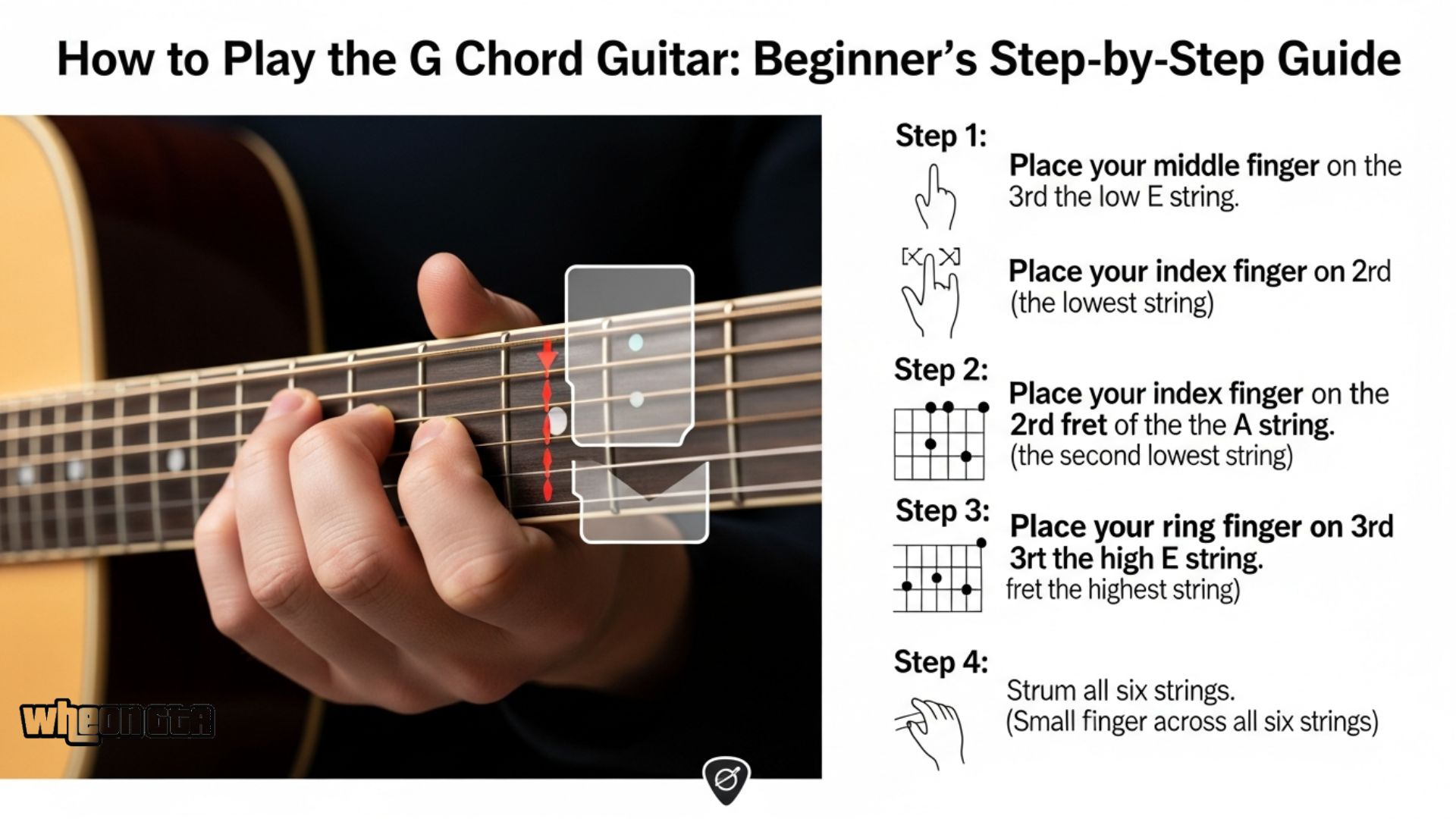
- Position your fingers: Place your index finger on the 2nd fret of the A string (that’s the 5th string from the top). Your middle finger goes on the 3rd fret of the low E string (6th string). Finally, put your ring finger on the 3rd fret of the high E string (1st string).
- Check your form: Keep your thumb behind the neck for support, like you’re hitchhiking. Curve your fingers so only the tips touch the strings—avoid flattening them, or you’ll mute nearby notes.
- Strum it out: Strum all six strings from the low E down. It should ring clear and bright. If it buzzes, adjust slightly.
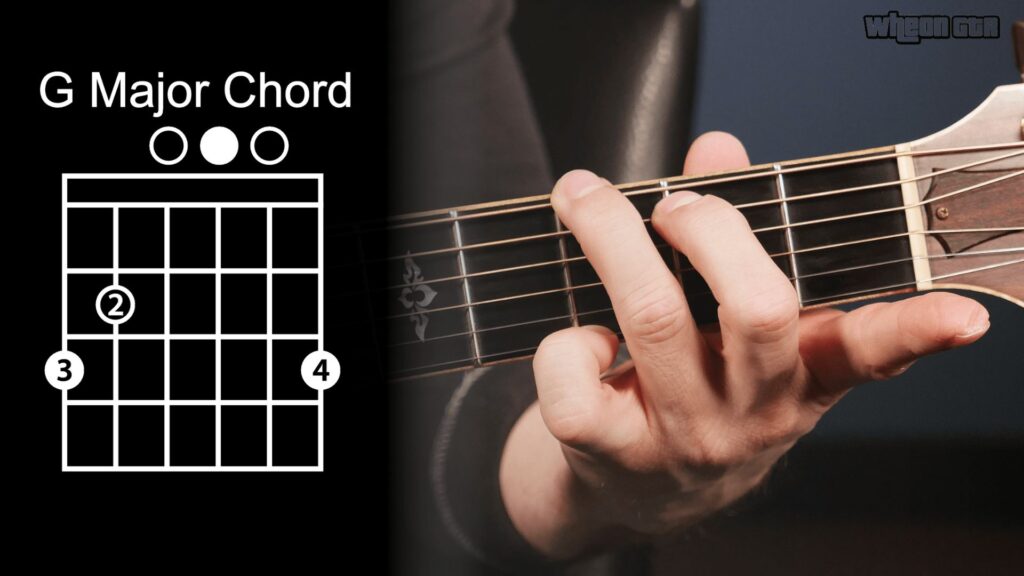
That visual should help! This is the classic “234” fingering (using fingers 2, 3, and 4). I’ve taught this to kids in guitar circles, and it clicks fast because it’s straightforward. Practice slowly at first—strum once, lift your fingers off, then replace them. In a week, it’ll feel natural.
If you’re on an acoustic guitar, press a bit harder on steel strings; electrics are more forgiving. And fun fact: This shape dates back to early folk music, where open chords like G allowed for easy singing accompaniment.
Tips and Troubleshooting for a Clean G Chord Sound
Ever strum the G chord and hear a dull thud instead of that crisp ring? It’s frustrating, but fixable. From my experience playing in small bands, most issues boil down to finger placement or hand tension. Let’s troubleshoot like pros.
First, curve those fingers! Imagine holding a small ball in your palm—that keeps the fleshy parts from muting strings. Snuggle your fingers right up to the frets (the metal lines) for less pressure needed. If buzzing persists, check your guitar setup; old strings can make even perfect form sound off.
Pro tip: Start with slow transitions. Practice going from G to C (a common pair) by keeping your ring finger planted as an anchor. It reduces movement and speeds things up. Another hack? Use a mirror to watch your hand—it’s like having a personal coach.
For extra clarity, avoid playing too hard; gentle pressure is key. And if your nails are long, trim them— they’ll get in the way. With daily 10-minute sessions, you’ll hear improvement. Remember, even legends like Johnny Cash started somewhere, fumbling through these basics.
Exploring G Chord Variations: Spice Up Your Playing
Once you’ve got the basic G down, why stop there? Variations add flavor, making your playing sound fuller or easier in certain songs. There are at least eight ways to play G major on guitar, from open to barre shapes.
Try this fuller open version for a richer tone:
- Index on 2nd fret, A string.
- Middle on 3rd fret, low E.
- Ring on 3rd fret, B string (2nd string).
- Pinky on 3rd fret, high E.
Strum all six—it’s great for folk tunes and easier to switch to C or Em.
For simplicity, use a two-finger G: Index on 3rd fret, high E; middle on 3rd fret, B. Strum the top three strings. Perfect for quick jams or if stretching feels tough.
Then there’s the barre G at the 3rd fret—index bars all strings at 3, ring on 5th fret A and D, pinky on 5th fret G. It’s movable, so you can slide it up for other chords like A or B. Barre chords build strength, but start slow to avoid cramps.
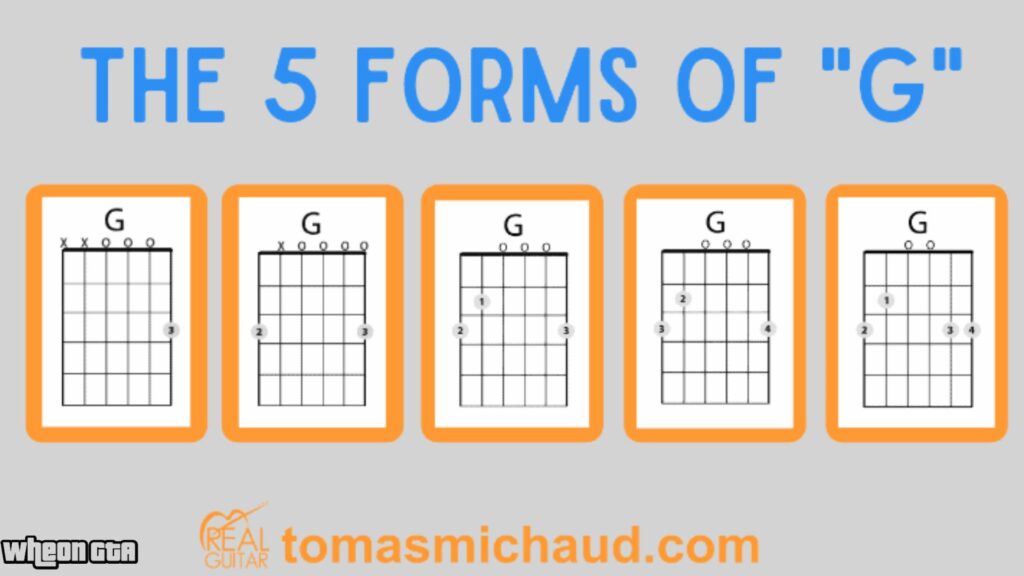
These tweaks come from centuries of guitar evolution, where players adapted for different styles, like rock needing punchier sounds. Experiment in your practice—mix them in songs to see what fits.
Common Mistakes When Playing the G Chord and How to Fix Them
Ah, the pitfalls—we’ve all been there. One biggie is muting the A string with your index finger. Fix it by arching your wrist more, creating space. Another? Stretching too far for the high E; if your hands are small, try the pinky instead of ring finger.
Beginners often press too hard, tiring their hands. Lighten up—let the frets do the work. And don’t angle your wrist out; keep it straight to avoid strain.
Real talk: I once buzzed through an entire song at a party because my strings were worn. Change them every 3-6 months for better tone. Practice isolating the chord—strum each string alone to spot mutes. With patience, these slip-ups become rare.
Smooth Transitions: Moving to and From the G Chord
Transitions can make or break a song. The G to C switch is notorious because it involves rearranging all fingers. Here’s a trick: Use the “folk G” with ring and pinky on B and high E—it lets you pivot without lifting much.
For G to D, keep your index as a guide finger sliding down. Practice in loops: Strum G four beats, switch to C four beats, repeat. Start at 60 BPM with a metronome app.
From personal gigs, smooth changes come from muscle memory—play daily, even if just 5 minutes. Anchor fingers help; for A to G, slide your middle finger while stretching vertically. Soon, you’ll flow effortlessly.
Popular Songs Featuring the G Chord on Guitar
Nothing motivates like real songs! The G chord shines in hits using the G-Em-C-D progression, like “Wonderwall” by Oasis or “Hey There Delilah” by Plain White T’s.
Here’s a quick list of beginner-friendly tracks:
- “Good Riddance (Time of Your Life)” by Green Day: Mostly G, C, D—perfect for strumming practice.
- “Ring of Fire” by Johnny Cash: Classic country with G as the anchor.
- “Save Tonight” by Eagle-Eye Cherry: Simple G-C-D-Em loop.
- “Zombie” by The Cranberries: Energetic rock vibe.
- “With or Without You” by U2: Builds emotion with G variations.
Even “Fade Into You” by Mazzy Star uses G-D-Am for a dreamy feel. Start with these; they’re forgiving and fun. Search tabs online, but play by ear too—it sharpens skills.
Practice Exercises to Master the G Chord
To really own the G chord guitar technique, practice smart. Warm up with finger stretches: Touch thumb to each fingertip, then reverse.
Try this drill:
- Strum G four times, lift, repeat 10x.
- Alternate G and C: 4 beats each, 5 minutes.
- Play a simple progression: G-Em-C-D, looping for songs.
Use apps like ChordBank for guided practice—they listen and correct you. Or flashcards for quick switches.
For fun, jam to backing tracks on YouTube. Consistency is key—15 minutes daily beats hours sporadically. Track progress; record yourself weekly to hear growth.
A Bit of History: The G Chord’s Role in Guitar Music
The G chord has roots in Baroque guitar tuning from the 16th century, where open chords like G allowed for resonant playing without complex fingerings. It evolved with folk and blues, becoming a staple in Western music for its bright, major sound.
In theory, it’s a triad (root, third, fifth), but guitarists add extensions for jazz or rock. Knowing this adds depth—it’s not just notes; it’s musical heritage.
Wrapping up, mastering the G chord on guitar opens doors to endless creativity. You’ve got the tools now: basics, tips, variations, and songs. Keep practicing, stay patient, and soon you’ll be the one leading the sing-alongs. Remember, every pro was a beginner once. Grab your guitar, strum that G, and enjoy the journey!
If this sparked your interest, check out guides on other open chords like C or D. What’s your favorite G chord song? Share in the comments—let’s build a community of strummers!
FAQ
Q: How do I play the G chord on guitar for beginners?
A: Start with the open position: Index on 2nd fret A string, middle on 3rd fret low E, ring on 3rd fret high E. Strum all six strings. Curve fingers to avoid muting, and practice slowly. This G chord guitar basics will help you play songs like “Good Riddance” in no time—aim for 10 minutes daily to build muscle memory without frustration.
Q: What are common G chord variations on guitar?
A: Try the fuller version with pinky on 3rd fret high E and ring on B string for richness. Or the barre G at 3rd fret for movability. These G chord guitar tweaks suit different styles, like folk or rock. Experiment to find what fits your hand size—barre takes practice but unlocks higher frets effortlessly.
Q: Why does my G major chord sound buzzy on guitar?
A: Buzzing often comes from not pressing hard enough or muting strings with flat fingers. Curve them and snug up to frets. Check old strings too. For G chord guitar troubleshooting, strum each string solo to isolate issues. With adjustments, it’ll ring clear—many beginners fix this in a week of focused practice.
Q: What songs use the G chord on guitar?
A: Hits like “Ring of Fire” by Johnny Cash and “Zombie” by The Cranberries feature the G chord prominently. It’s key in G-Em-C-D progressions. Playing these G chord guitar songs builds confidence; start slow with tabs. They’re perfect for campfires or parties, showing how one chord ties into real music magic.
Q: How to transition smoothly to the G chord on guitar?
A: Use anchor fingers—like keeping ring on high E when switching from C. Practice loops at slow tempo. For G chord guitar transitions, apps help time you. Common pairs like G to D get easier with repetition—I’ve seen students master this in days, turning choppy playing into smooth, enjoyable sessions.