Grand Theft 3rd Degree: What It Means and How to Handle It
Hey there, friend. Imagine this: You’re at a busy flea market, eyeing that shiny old watch your grandpa used to wear. It looks just like his, and in a split second, you grab it thinking it’s yours from way back. But nope—turns out it’s someone else’s prized heirloom, valued at $1,200. Suddenly, you’re slapped with a grand theft 3rd degree charge. Heart racing, right? That gut-punch feeling is what we’re diving into today.
If you’ve ever wondered what grand theft 3rd degree really means—or if you’re facing it right now—this post is your friendly guide. We’ll break it down like chatting over coffee: simple, no legalese overload. We’ll cover what it is, why it happens, penalties that hit hard, and smart ways to fight back. Stick with me; by the end, you’ll feel less like a deer in headlights and more like you’ve got a map out of the mess.
Grand theft 3rd degree isn’t just a fancy term—it’s a felony that can flip your life upside down. But knowledge is power, and understanding it is your first step to staying steady.
What Exactly Is Grand Theft 3rd Degree?
Let’s start at the basics, okay? Grand theft 3rd degree is when someone takes property that doesn’t belong to them, and it’s worth a certain amount or fits special categories. Think of it as the “oops, that’s too big to brush off” level of stealing. Unlike petty theft—like snagging a candy bar—this one’s a felony because the stakes are higher.
In plain English, it’s unlawful taking with the intent to keep it or mess with the owner’s rights. No, it’s not always about cars (though that can count!). It could be jewelry, electronics, or even services like tricking someone out of rent money. The key? Intent. You have to mean to deprive the owner for good—or at least act like it.
Key Elements Prosecutors Must Prove
To nail you on this, the state has to show a few things. Miss one, and the case crumbles. Here’s the rundown in simple bullets:
- You took something: Property, cash, or services that belong to another person or business.
- It was wrong: No permission, no legal right—like borrowing without asking and not giving back.
- Value or type matters: Usually $750 to $20,000 in places like Florida, or specific items like a gun or car, no matter the price tag.
- Intent to keep: You planned to make it yours or trash the owner’s claim.
Real talk: These elements sound straightforward, but they’re not. I’ve seen cases where a simple mix-up in who owned what turned a scary charge into a slap on the wrist. That’s why digging deep matters.
Fun fact to lighten it up: Laws like this go back centuries, from old English “larceny” rules. Today, it’s all about protecting folks’ hard-earned stuff in our grab-and-go world.
How Grand Theft 3rd Degree Differs from Other Theft Crimes
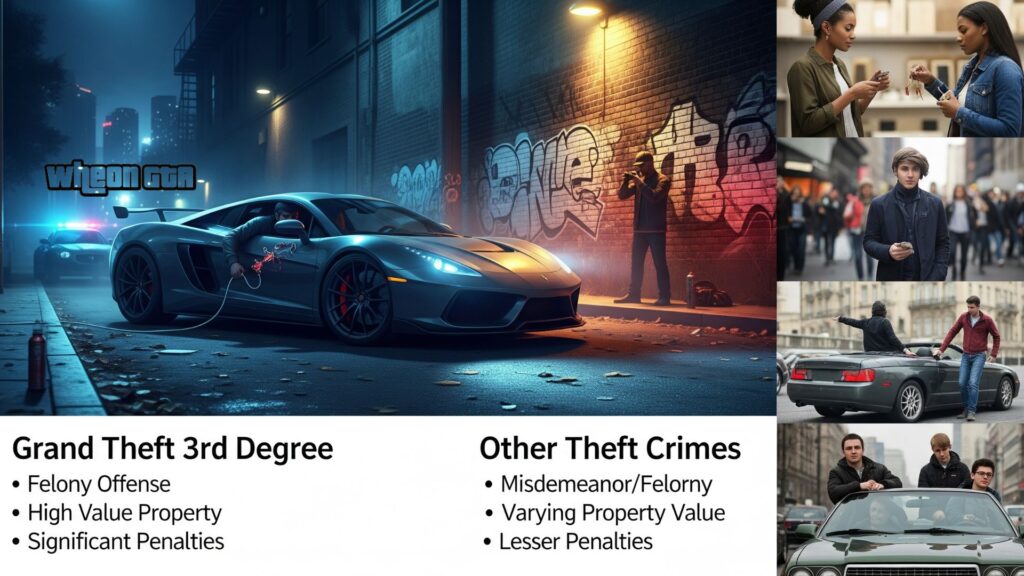
Not all thefts are created equal—it’s like levels in a video game, where each step up means tougher bosses (and penalties). Grand theft 3rd degree sits in the middle: serious, but not the worst. Let’s compare it quick, so you see where it fits.
| Theft Type | Value Threshold (Florida Example) | Classification | Max Penalty |
| Petit Theft | Under $750 | Misdemeanor | Up to 1 year jail, $1,000 fine |
| Grand Theft 3rd Degree | $750–$20,000 (or special items like firearms) | 3rd Degree Felony | Up to 5 years prison, $5,000 fine |
| Grand Theft 2nd Degree | $20,000–$100,000 (or cargo/theft from many homes) | 2nd Degree Felony | Up to 15 years prison, $10,000 fine |
| Grand Theft 1st Degree | Over $100,000 (or major damage with a vehicle) | 1st Degree Felony | Up to 30 years prison, $10,000 fine |
See? Grand theft 3rd degree is the entry-level felony, but it packs a punch. In other states, lines blur—New York’s grand larceny 3rd degree kicks in at $3,000, while Texas lumps it under felony theft at $2,500+. Always check your local rules, ’cause they vary like pizza toppings.
Why the differences? States tweak laws based on local needs. Florida’s strict on home thefts (even $40 from a house counts as grand 3rd degree), while Texas eyes repeat offenders harder. It’s all about balancing fairness with deterrence.
Short story time: My buddy’s cousin in Texas thought swiping a $1,000 bike was just “borrowing.” Nope—felony territory there, unlike a misdemeanor elsewhere. Lesson? Location flips the script.
Common Examples of Grand Theft 3rd Degree in Real Life
Stories make this stick, don’t they? Let’s walk through everyday scenarios that land folks in hot water. These aren’t made-up—they’re inspired by real cases, simplified for clarity.
Scenario 1: The Shoplifting Slip-Up
Picture Sarah, a single mom short on cash. She stuffs a $900 designer bag into her cart at the mall, thinking she’ll pay later. Security cams catch her bolting without it. Boom—grand theft 3rd degree. Why? Value over $750, intent clear as day. In Florida, she’d face felony charges, even if it’s her first time.
Real twist: In a 2023 Florida case, a teen did this with electronics totaling $1,200. He claimed “forgot to pay,” but the judge saw intent. Ended up with probation, but the scare changed his life.
Scenario 2: Stealing from Home or Work
Uncle Joe “borrows” his roommate’s $800 gaming console during a move, intending to sell it for rent money. Roomie reports it—grand theft 3rd degree, especially if from a dwelling (Florida ups the ante for home thefts over $40). Or at work: An employee skims $2,000 from the till over weeks. Embezzlement? Same charge.
From the headlines: Remember that 2022 New York story where a nanny took $4,500 in family jewelry? Charged as grand larceny 3rd degree. She argued it was a gift—jury didn’t buy it.
Scenario 3: Vehicle or Firearm Fiascos
No value needed here—steal a car worth $5,000? Grand 3rd degree. Same for guns. A guy in Texas hot-wires a $10,000 truck for a joyride that turns permanent. Felony city.
Quick list of sneaky ones that qualify:
- Firearms: Any gun, even a $200 pistol.
- Vehicles: Motorcycles, boats—anything motorized over a bike.
- Wills or Documents: Stealing grandma’s will to change inheritance.
- Farmed Animals: $750+ in livestock (yep, cows count!).
These examples show it’s not just “big heists.” Everyday choices snowball. But here’s hope: Many get reduced if you act fast with a good lawyer.
Penalties for Grand Theft 3rd Degree: What You Could Face
Oof, the scary part. Convicted of grand theft 3rd degree? It’s a third-degree felony in most spots like Florida. Penalties hit hard, but they’re not always maxed out—judges consider your record, remorse, and story.
Prison and Fines Breakdown
- Jail Time: Up to 5 years in state prison. First-timers might get probation instead—think 1-3 years supervised, with rules like no-contact zones.
- Fines: $5,000 max, plus court fees. Oh, and restitution—you pay back the victim’s loss, dollar for dollar.
- Probation: Often 5 years, packed with community service (100+ hours), drug tests, or job mandates.
Beyond bars: Lose your driver’s license for a year, vote rights suspended (Florida’s tough on felons), and jobs? Forget banking or teaching gigs. One study shows felony theft convictions cut job offers by 50%.
In Texas, it’s 2-10 years for similar felony theft, while New York’s class D felony means up to 7 years. Varies, but the sting’s universal.
Real-life nudge: A Florida woman in 2024 stole $1,500 in tools from her ex’s garage. First offense, she got 18 months probation and $2,000 restitution. Cooperation saved her from lockup.
Disclaimer: This isn’t legal advice—penalties depend on your case. Chat with a pro for your spot.
Variations in Grand Theft 3rd Degree Laws Across States
Laws aren’t one-size-fits-all. Florida’s $750 threshold is low compared to California’s $950 for grand theft. Let’s spotlight three big ones.
Florida: Strict and Specific
Home to beaches and tough theft rules. Grand 3rd degree if $750+, or any firearm/vehicle. From dwellings? Even $40 triggers it. Penalties: 5 years max.
New York: Value-Focused Larceny
Calls it “grand larceny 3rd degree” at $3,000+. Class D felony—up to 7 years. ATM thefts auto-qualify. More leeway for low-value but high-impact items.
Texas: Repeat-Offender Heavy
Felony theft at $2,500+, third-degree (2-10 years). Prior thefts bump it up fast. Focuses on aggregation—if you steal bits totaling over threshold, it counts as one big hit.
Why care? If you’re traveling or moving, a charge in one state tags you nationwide. Federal background checks see it all.
Pro tip: Use tools like state statutes online (e.g., Florida’s at leg.state.fl.us) for quick peeks. But don’t DIY—get local help.
Building a Strong Defense: Strategies That Work
Facing charges? Don’t freeze—fight smart. Defenses poke holes in the prosecution’s story. Remember, they must prove every element beyond doubt. Here’s how to push back.
Top Defenses to Consider
- Lack of Intent: “I thought it was mine!” Mistake of fact kills this— like grabbing the wrong backpack. Courts buy it if believable.
- Claim of Right: You honestly believed you owned it or had permission. Ex: Family heirloom disputes.
- Alibi or Wrong Person: Weren’t you at the dentist? Witnesses or cams prove it.
- Value Challenge: Argue the item’s worth less than $750. Get an appraiser—original price doesn’t always count; it’s current market value.
- Entrapment or Duress: Cops pushed you, or threats forced your hand (rare, but real).
In a 2021 Florida win, a man beat charges by showing the “stolen” laptop was a gift—receipts sealed it.
Steps to Take Right Now
- Shut Up and Lawyer Up: No chats with cops without counsel. Miranda rights aren’t kidding.
- Gather Proof: Photos, receipts, witness contacts—build your side early.
- Diversion Programs: First-timers? Ask for pretrial intervention—complete classes, charges drop.
- Plea Bargains: Reduce to misdemeanor? Common if evidence wobbles.
Expert insight: Stats show 70% of felony thefts plea down with good reps. Don’t go solo.
Short para wrap: Defending isn’t about guilt—it’s about fairness. A solid strategy turns “maybe guilty” into “not proven.”
Life After a Grand Theft 3rd Degree Conviction: Bouncing Back

Convicted? It’s rough, but not game over. That felony sticks, but folks rebuild. Here’s the real talk on fallout and fixes.
Immediate Hits
- Jobs and Housing: Background checks flag it. 30% of landlords say no to felons.
- Rights Loss: No voting (some states), guns, or certain licenses till expunged.
- Daily Grinds: Higher insurance, loans denied—stress piles up.
Paths to Recovery
- Expungement/Sealing: Florida allows after 10 years clean. NY’s faster for some.
- Job Help: Programs like Ban the Box hide it initially.
- Counseling: Theft often ties to bigger issues—therapy helps roots.
Inspiring tale: A Texas guy convicted in 2019 now runs a tool repair shop after probation. “Paid my debt, owned my mistake—now I fix what others break.”
You’re more than a label. Focus on growth; support’s out there.
Wrapping It Up: Knowledge Is Your Best Defense
Whew, we covered a lot—from what grand theft 3rd degree looks like in daily slip-ups to fighting back with smart moves and eyeing life post-charge. It’s scary stuff, sure, but remember: One mistake doesn’t define you. Laws exist to protect, but they also give room for fairness if you grab the right help.
The big takeaway? Act fast, stay honest, and lean on pros. Whether it’s a misunderstanding or a tough lesson, you’ve got options. If this hits home, reach out to a local attorney today no shame in building a safety net.
Thanks for reading, pal. Drop a comment if you’ve got questions or a story to share. Let’s keep the convo going after all, understanding keeps us all a step ahead.
FAQs
Q: Is grand theft 3rd degree always a felony?
A: Yes, in most states like Florida, it’s a third-degree felony. But thresholds vary—under $750 often drops to misdemeanor petit theft.
Q: Can I get probation instead of jail for grand theft 3rd degree?
A: Absolutely, especially first-timers. Judges often opt for 1-5 years probation with community service and restitution over prison.
Q: How does property value get determined in these cases?
A: It’s fair market value at theft time not original price. Experts like appraisers testify; you can challenge it to lower the charge.
Q: What’s the statute of limitations for grand theft 3rd degree?
A: Usually 5 years in Florida, but check your state. Prosecutors must charge within that window from the crime date.
Q: Can grand theft 3rd degree be expunged from my record?
A: Possible after completing sentence and staying clean wait times vary (e.g., 10 years in Florida). A lawyer helps navigate sealing options.