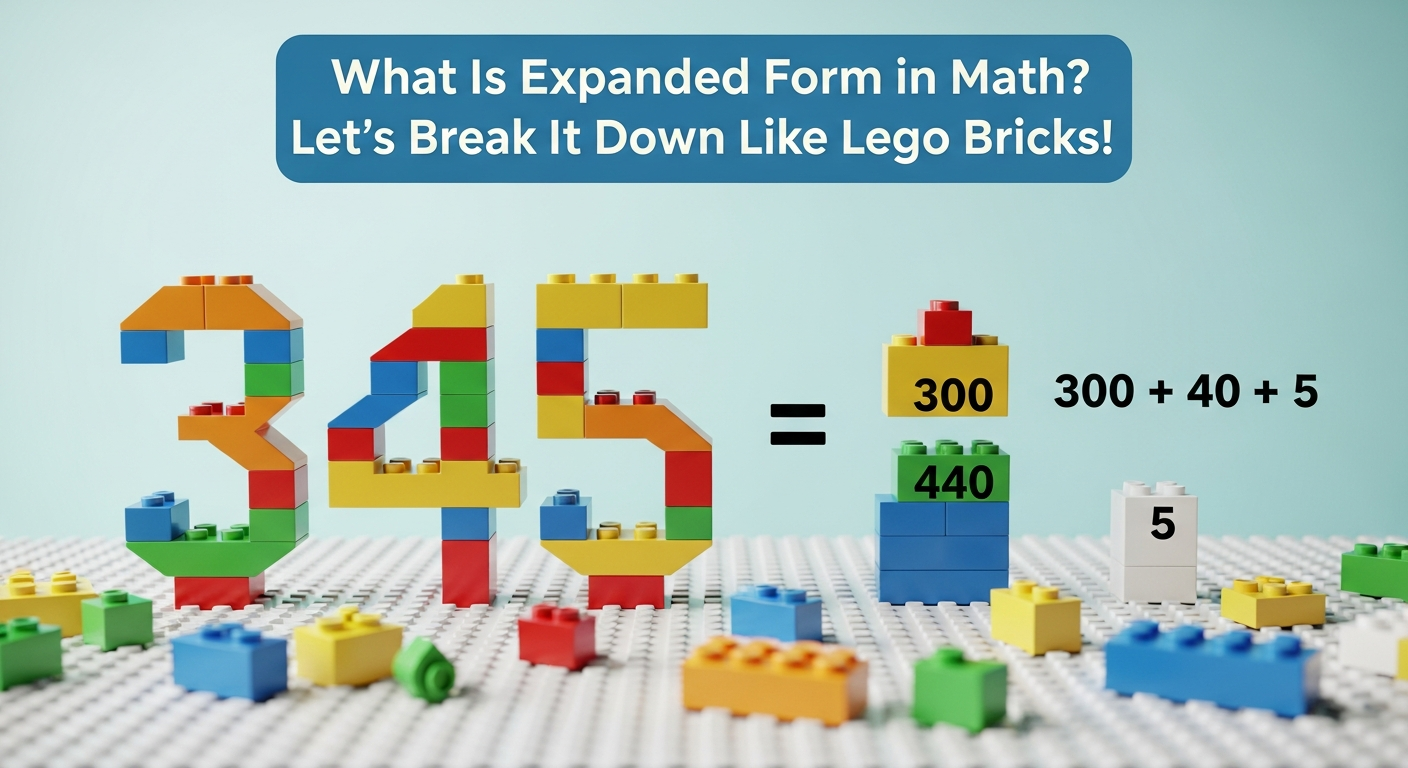
What Is Expanded Form Math? Let’s Break It Down Like Lego Bricks!
Hey there, awesome parents and curious kids! 😄 Have you ever looked at a number like 3,456 and wondered, “What are you really made of?” That’s exactly what expanded form in math helps us do—it’s like taking the number apart into its place value pieces, just like snapping Lego bricks apart to see each colorful block.
Imagine your number is a tasty pizza. The whole pizza is 3,456 slices (yum!). Expanded form shows us:
- 3 thousands slices
- 4 hundreds slices
- 5 tens slices
- 6 ones slices
When we write it out, it becomes: 3,000 + 400 + 50 + 6
That’s expanded form! Easy-peasy, right?
Today we’re going on a fun adventure to master expanded form, standard form, word form, and place value together. Ready? Let’s go!
Read More : What Is Area in Math? Easy Explanation with Real-Life Examples
Why Do Kids Need to Learn Expanded Form in Math?
Teachers don’t teach this just to fill workbook pages (promise!). Here’s why expanded form is a superhero skill:
- It helps kids really understand place value (the magic behind big numbers).
- It makes adding, subtracting, and comparing huge numbers way easier.
- It stops silly mistakes—like thinking 500 + 20 is 5200.
- It builds a strong math foundation for middle school and beyond.
Think of it as learning the “ingredients” before baking the cake!
How to Write a Number in Expanded Form – Step by Step
Let’s use the number 5,728 as our playground.
Step 1: Know Your Place Values
From right to left:
- Ones → Tens → Hundreds → Thousands → Ten thousands → etc.
So in 5,728:
- 5 is in the thousands place → 5,000
- 7 is in the hundreds place → 700
- 2 is in the tens place → 20
- 8 is in the ones place → 8
Step 2: Write It with Plus Signs
Expanded form: 5,000 + 700 + 20 + 8
Step 3: You Can Even Go Further (Expanded Form with Multiplication!)
Some teachers love this version: ** (5 × 1,000) + (7 × 100) + (2 × 10) + (8 × 1) **
Both ways are correct! The first one is perfect for younger kids.
Fun Expanded Form Examples Kids Love
Example 1: Small Number – 346
Expanded form: 300 + 40 + 6 Or: (3 × 100) + (4 × 10) + (6 × 1)
Example 2: Bigger Number – 45,809
- 40,000 + 5,000 + 800 + 0 tens + 9 ones → 40,000 + 5,000 + 800 + 9 (We skip the zero tens because it doesn’t change anything!)
Example 3: Money! $123.45
Decimals work too! 100 + 20 + 3 + 0.40 + 0.05 Or simply: $100 + $20 + $3 + 40¢ + 5¢
Expanded Form vs Standard Form vs Word Form – What’s the Difference?
Kids mix these up all the time, so here’s a super clear chart:
| Type | Example (using 4,567) | What It Looks Like |
|---|---|---|
| Standard Form | The normal number | 4,567 |
| Expanded Form | Broken into place value parts | 4,000 + 500 + 60 + 7 |
| Word Form | Written in words | four thousand, five hundred sixty-seven |
| Expanded with Multiplication | Shows the math behind it | (4 × 1,000) + (5 × 100) + (6 × 10) + (7 × 1) |
Seeing them side by side makes everything click!
Super Fun Ways to Practice Expanded Form at Home
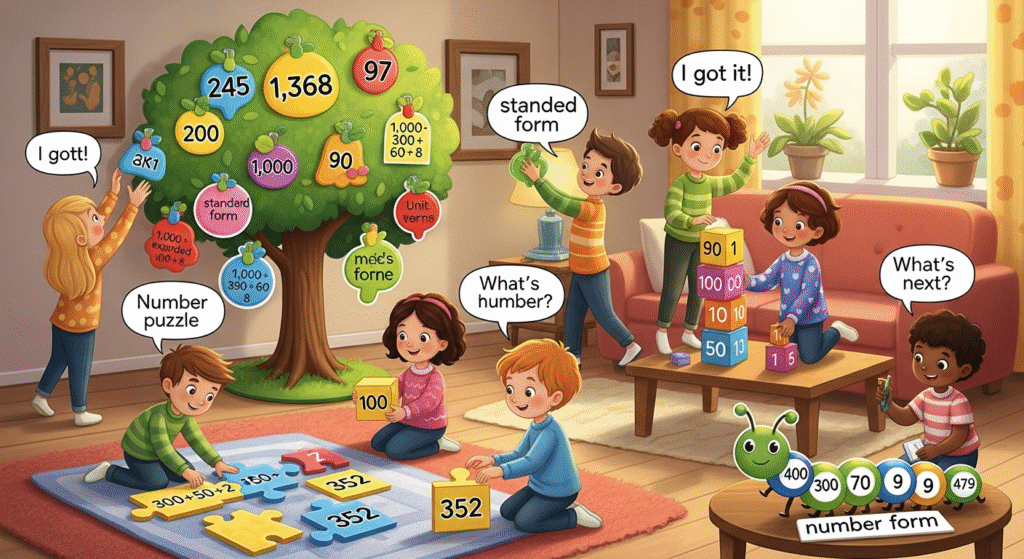
- Mystery Number Game Parent writes expanded form (like 2,000 + 300 + 50 + 4). Kid shouts the standard form (2,354). Swap roles!
- Lego Expanded Form Use real Lego bricks! 4 blue thousands bricks + 6 green hundreds = build the number!
- Grocery Store Math Look at prices: $89.99 → say it in expanded form together: 80 + 9 + 0.90 + 0.09.
- Expanded Form Worksheets with a Twist Draw the number as a robot: thousands box = head, hundreds = body, etc. So fun!
- Online Games There are tons of free expanded form games where kids drag and drop place values (just search “expanded form games” with your child).
Common Mistakes Kids Make (and How to Fix Them)
- Forgetting zeros: 4,209 → kids write 4,000 + 200 + 9 → missing the 0 tens! Fix: Always say the number out loud and point to each digit.
- Writing 400 + 60 + 7 as 4607 → adding instead of keeping plus signs. Fix: Remind them expanded form is “showing your work,” not solving yet.
- Confusing word form and expanded form on tests. Fix: Make a little song! “Expanded has pluses, words have letters!”
Expanded Form with Decimals – Yes, It Works There Too!
Let’s try 234.56
- 200 + 30 + 4 + 0.5 + 0.06 Or:
- (2 × 100) + (3 × 10) + (4 × 1) + (5 × 1/10) + (6 × 1/100)
This helps kids understand that decimals are just “smaller place values” on the right side of the decimal point.
How Expanded Form Helps With Bigger Math Later
Once kids rock expanded form:
- Adding big numbers becomes a breeze (line up place values!).
- Subtracting with regrouping makes sense.
- Multiplying by powers of 10 is instant (just add zeros!).
- Even algebra! Variables are like “unknown place values.”
It’s like giving your child X-ray glasses for numbers.
Real-Life Story: How My Student Finally “Got It”
Last year I had a third-grader named Mia who cried over place value every week. We started building numbers with base-10 blocks and writing them in expanded form together. Two weeks later? She was teaching her little brother! Seeing her face light up when she wrote 6,000 + 400 + 50 + 9 all by herself—that’s why I love teaching expanded form in math.
Conclusion
Expanded form in math isn’t just another boring topic—it’s the secret code that unlocks how numbers really work. When kids learn to break numbers apart and put them back together, they gain confidence that lasts forever.
So grab some paper, crayons, or even snacks, and start expanding numbers together today. You’ll be amazed at how quickly your child goes from “Math is hard” to “This is actually fun!” You’ve got this—and they’ve got this too!
Keep practicing, keep smiling, and remember: every big number started as little pieces put together with love (and a few plus signs!).
FAQ Section
Q: What is expanded form in math?
A: Expanded form is when you break a number into its place value parts using addition, like 567 = 500 + 60 + 7.
Q: How do you write 3,452 in expanded form?
A: 3,452 in expanded form is 3,000 + 400 + 50 + 2. It shows each digit’s place value clearly.
Q: What is the difference between standard form and expanded form?
A: Standard form is the regular number (like 8,901). Expanded form splits it: 8,000 + 900 + 0 + 1.
Q: How do you teach expanded form to kids easily
? A: Use base-10 blocks, draw place value houses, or play “build the number” games with toys—kids learn fast!
Q: Can decimals have expanded form too?
A: Yes! 45.67 = 40 + 5 + 0.60 + 0.07 or (4 × 10) + (5 × 1) + (6 × 0.1) + (7 × 0.01).