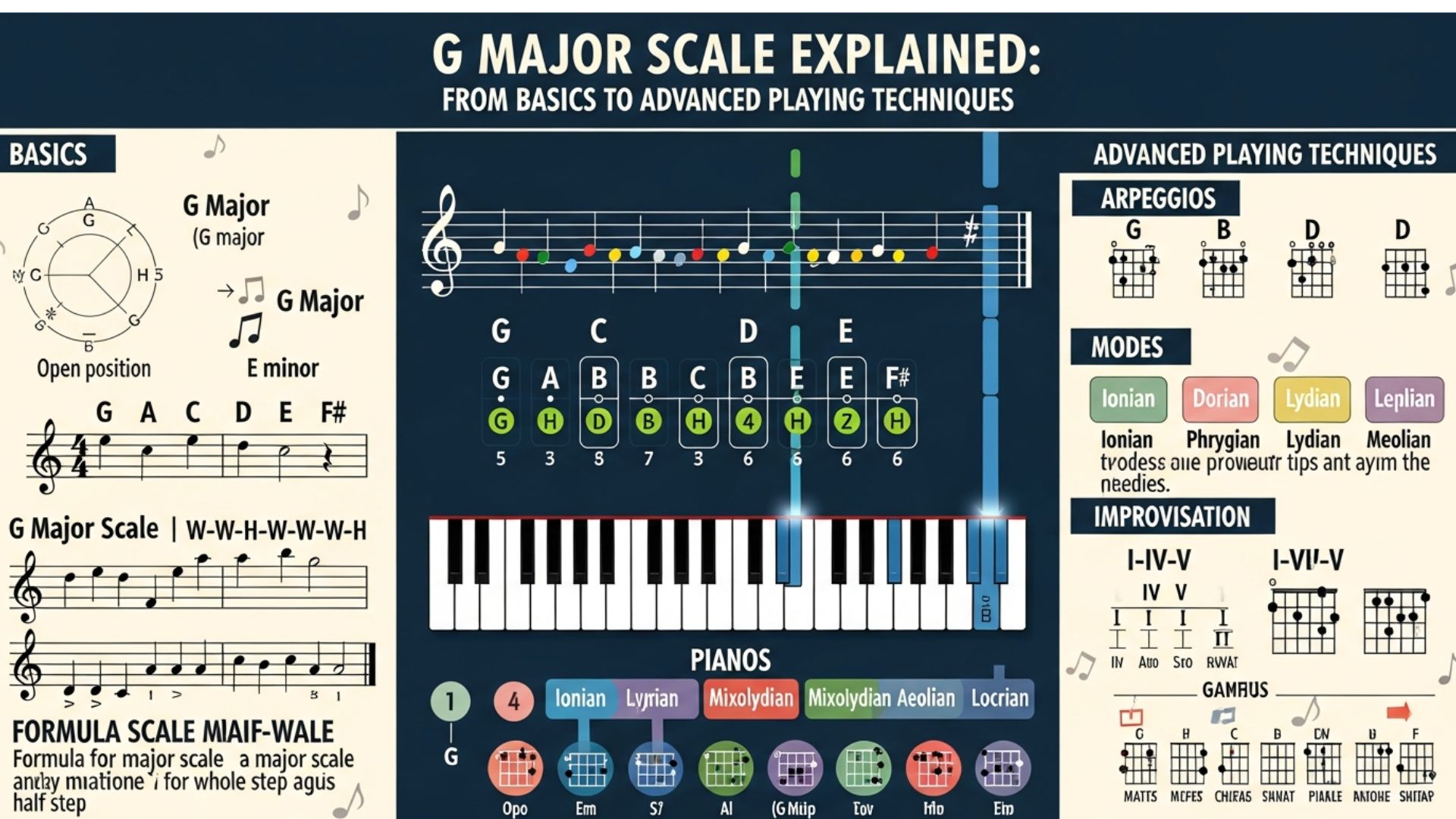
G Major Scale Explained From Basics to Advanced Playing Techniques
Hey there, music lover! Imagine you’re sitting at your piano or strumming your guitar, and suddenly, everything clicks. You’re playing a bright, happy tune that makes everyone smile. That’s the magic of the G major scale. If you’ve ever felt lost in music theory or wondered why some songs just feel “right,” you’re in the perfect spot. Today, we’re diving into the G major scale—its notes, how it works, and why it’s a game-changer for beginners. Whether you’re picking up an instrument for the first time or brushing up on basics, this guide will make it fun and simple. Let’s get started on this musical adventure!
I remember my first time learning scales as a kid. It felt like solving a puzzle, but once I got it, songs like “Twinkle Twinkle Little Star” came alive. The G major scale is one of the friendliest ones out there, with just one sharp note to worry about. It’s used in tons of popular music, from folk tunes to rock hits. Stick with me, and by the end, you’ll be playing it like a pro.
What Is the G Major Scale? Breaking It Down Simply
So, what exactly is the G major scale? Think of it as a ladder of notes that climbs up in a happy, uplifting way. In music, scales are the building blocks for melodies and harmonies. The G major scale starts on the note G and follows a specific pattern of steps—whole steps and half steps—that give it that cheerful sound.
The notes in the G major scale are: G, A, B, C, D, E, F#. Notice that F#? That’s the sharp note, which means it’s raised a half step from regular F. Without it, the scale wouldn’t sound major—it might feel sad or minor instead. Major scales always follow this pattern: whole step, whole step, half step, whole step, whole step, whole step, half step. It’s like a secret code that musicians use everywhere.
Picture this: You’re at a park, and kids are climbing a playground ladder. Each rung is a note, and the gaps between them are those steps. If you skip a rung (whole step), it’s a bigger jump; a half step is just a tiny one. That’s how the G major scale feels—smooth and exciting. Compared to the C major scale, which has no sharps or flats, G major adds that one sharp for a bit more sparkle. It’s not too tricky, making it ideal for new players.
In real life, I’ve seen beginners light up when they play this scale on guitar. It fits nicely on open strings, so you don’t need fancy finger stretches right away. On piano, it’s mostly white keys with one black key (F#), which helps build confidence. Just remember, practice slowly at first—no rushing!
How to Play the G Major Scale on Piano: Step-by-Step Guid
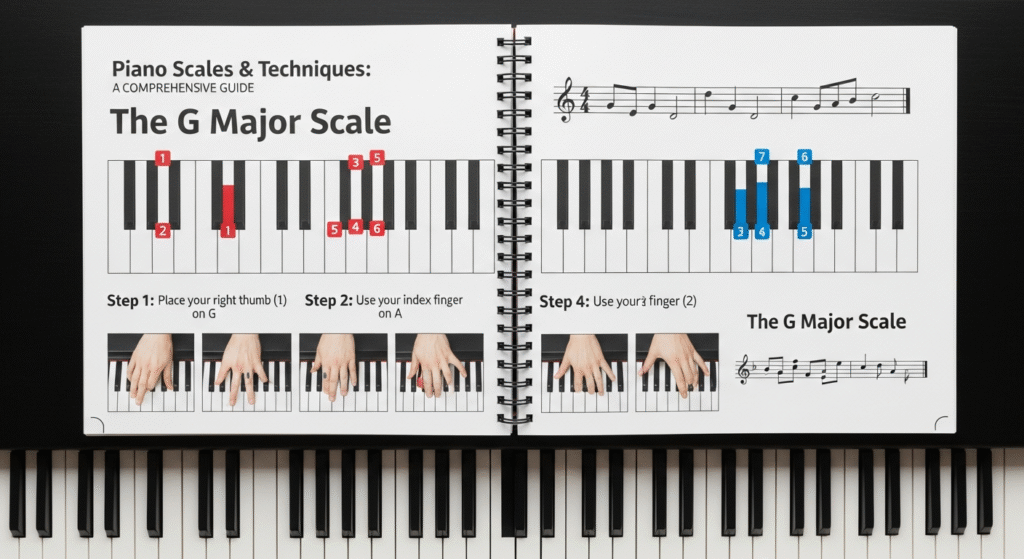
Ready to tickle those ivories? Playing the G major scale on piano is a breeze once you know the fingering. Start with your right hand: Thumb on G, index on A, middle on B, then thumb under to C, and so on up to F# with your pinky, ending on G again.
For the left hand, it’s pinky on G, ring on A, middle on B, index on C, thumb on D, then middle over to E, index to F#, and thumb to the top G. Sounds complicated? Nah, it’s like patting your head and rubbing your tummy—awkward at first, but fun once you get it.
Here’s a quick visual breakdown in a simple table to make it crystal clear:
| Hand | Starting Note | Fingering Sequence |
|---|---|---|
| Right | G | 1-2-3-1-2-3-4-5 |
| Left | G | 5-4-3-2-1-3-2-1 |
Why this fingering? It keeps your hands comfy and avoids twists. I’ve taught this to kids in music classes, and they love racing up and down the scale. Start slow, maybe 60 beats per minute on a metronome app, and speed up as you go. Pro tip: Play it ascending (up) and descending (down) to build muscle memory.
If you’re a visual learner, imagine the piano keys like a zebra—black and white stripes. In G major, you hit all white keys except that one black F#. It’s forgiving for beginners, unlike scales with more sharps like D major (two sharps). And hey, if you make a mistake, no biggie—music is about enjoying the journey, not perfection.
Mastering the G Major Scale on Guitar: Tips for Smooth Playing
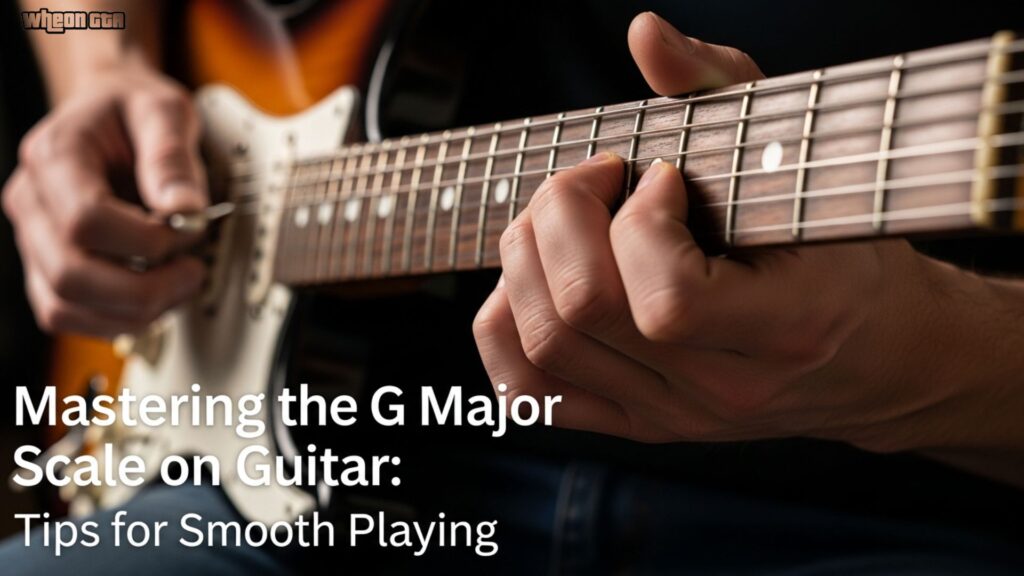
Switching to guitar? The G major scale is a guitarist’s best friend because it uses open strings for that ringing tone. In open position, start on the low E string, third fret (G), then up the strings hitting A on the open A, B on the second fret, and so forth.
Try this pattern:
- Low E string: 3rd fret (G), open A string (A), 2nd fret on A (B)
- D string: Open (D), 2nd fret (E), 3rd fret (F#)
- And repeat up and down.
It’s like climbing a fretboard mountain—each fret is a step. I once jammed with friends around a campfire, and knowing this scale let me improvise over songs like “Wonderwall” by Oasis, which is in G major. Cool, right?
For variations, try the pentatonic version of G major (notes: G, A, B, D, E) for bluesy solos. It’s a stripped-down scale that’s easier for jamming. Compared to other keys, G major avoids barre chords early on, so your fingers won’t cramp as much. Just practice with a pick or fingers, and record yourself to hear improvements. Disclaimer: If you’re new to guitar, warm up your hands to avoid strain—safety first!
Chords in the G Major Scale: Building Blocks for Songs
Now, let’s talk chords—the harmony side of the G major scale. Every scale has matching chords built on each note. In G major, the pattern is major, minor, minor, major, major, minor, diminished. So, the basic triads are:
- I: G major (G-B-D) – Bright and home base.
- ii: A minor (A-C-E) – Soft and thoughtful.
- iii: B minor (B-D-F#) – Adds tension.
- IV: C major (C-E-G) – Uplifting shift.
- V: D major (D-F#-A) – Builds excitement.
- vi: E minor (E-G-B) – Emotional depth.
- vii°: F# diminished (F#-A-C) – Rare but spicy.
These are like ingredients in a recipe. Mix them for progressions like I-IV-V (G-C-D), which powers classics like “Sweet Home Alabama.” I’ve written songs using these, and it’s amazing how they fit together naturally.
Add seventh notes for richer sounds: Gmaj7 (G-B-D-F#), Am7 (A-C-E-G), and so on. On piano, stack your fingers; on guitar, learn the shapes. Fun fact: Compared to A major (three sharps), G major’s chords are easier for open-position playing. Use them to compose your own tunes—start simple and experiment!
Common Songs Using the G Major Scale: Real-Life Examples
Ever wonder why some songs stick in your head? Many use the G major scale for its joyful vibe. Take “Yellow Submarine” by The Beatles—it’s mostly in G major, with that catchy melody climbing the scale notes.
Or “Ring of Fire” by Johnny Cash: The horn riff dances around G, A, B, C. I’ve played this at parties, and everyone sings along. For kids, “Happy Birthday” can be transposed to G major easily.
Modern hits? Ed Sheeran’s “Perfect” floats on G major chords. It’s versatile across genres—folk, pop, country. Compared to minor scales like E minor (same notes but starts on E), G major feels happier. Try humming these songs while practicing the scale; it’ll make theory come alive without feeling like homework.
Advanced Tips: Tetrachords and Solfege in G Major
Want to level up? Split the G major scale into tetrachords—two four-note groups. Lower: G-A-B-C (whole-whole-half). Upper: D-E-F#-G (same pattern, joined by a whole step).
This hack makes memorizing easier, like breaking a long story into chapters. In my experience teaching, students grasp big scales faster this way.
Then there’s solfege: Do (G), Re (A), Mi (B), Fa (C), Sol (D), La (E), Ti (F#), Do (G). Sing it like in “The Sound of Music”—Do-Re-Mi! It trains your ear to hear intervals. Pro singers use this for pitch accuracy. Compared to other systems, solfege is universal and fun. Give it a try in the shower; no one’s judging!
Notation and Key Signature: Reading the G Major Scale
Music notation might look like hieroglyphs, but it’s straightforward for G major. The key signature has one sharp on the F line/space, telling you to sharp every F.
On treble clef: Notes climb from G on the second line up to F# on the top space. Bass clef starts lower. I’ve seen beginners mix up sharps and flats—remember, G major is sharp territory.
Use apps like MuseScore for free practice sheets. It’s authoritative: All major scales follow the same interval rules, but G’s single sharp makes it beginner-friendly compared to F# major (six sharps—yikes!).
Conclusion
Whew, we’ve covered a lot on the G major scale, from its sunny notes to chords that make songs pop. Remember, it’s all about practice and fun—don’t stress if it takes time. This scale opens doors to countless tunes and boosts your confidence as a musician.
So, grab your instrument today and give it a go. Who knows? You might create your next favorite melody. Keep exploring music; it’s a lifelong adventure. If you have questions, drop them in the comments—happy playing!
FAQ Section
Q: What are the notes in the G major scale?
A: The G major scale includes G, A, B, C, D, E, and F#. It follows the major scale pattern of whole and half steps, making it sound bright and cheerful. Perfect for beginners on piano or guitar, this scale has one sharp (F#) and is used in many popular songs like “Yellow Submarine.” Practice slowly to master it!
Q: How do I play the G major scale on piano? A: Start with your right hand thumb on G, using fingers 1-2-3-1-2-3-4-5 up the scale. For left hand, begin with pinky on G and follow 5-4-3-2-1-3-2-1. Focus on smooth transitions and the F# black key. This fingering builds comfort—try it daily for quick progress in music skills.
Q: What chords are in the key of G major?
A: In the key of G major, chords include G major, A minor, B minor, C major, D major, E minor, and F# diminished. These follow the major-minor pattern and create popular progressions like G-C-D. Great for songwriting, they’re easy on guitar with open shapes—experiment to unlock folk and pop tunes.
Q: Why is the G major scale important for beginners?
A: The G major scale is beginner-friendly with just one sharp, helping build finger strength and ear training. It teaches intervals and leads to simple songs, boosting confidence. Unlike scales with more sharps, it’s less intimidating—use it as a foundation for music theory and improvisation on any instrument.
Q: How does the G major scale differ from other major scales?
A: Compared to C major (no sharps), G major has one sharp (F#), adding a unique brightness. It shares notes with E minor but starts on G for a happier feel. Ideal for guitarists due to open strings, it contrasts with sharper keys like A major—master it to expand your repertoire effortlessly