
Mastering 9th Grade Math Essential Tips to Overcome Algebra Struggles
Hey there! Remember that feeling when you first step into high school and suddenly math feels like a whole new world? If you’re a student, parent, or even a teacher diving into 9th grade math, you’re not alone. It’s that exciting yet tricky year where things shift from basic arithmetic to more abstract ideas like solving equations and understanding shapes in space. But don’t worry—I’ve got your back. In this guide, we’ll break down 9th grade math in a way that’s fun, straightforward, and super helpful. Whether you’re prepping for tests or just trying to make sense of it all, let’s turn those “aha!” moments into everyday wins.
Think about it: 9th grade math isn’t just about numbers on a page. It’s the foundation for everything from engineering dreams to everyday budgeting. We’ll cover the core topics, throw in some real-life examples, and share tips that make it stick. By the end, you’ll feel more confident tackling those homework problems. Ready to jump in?
Read More : Rise Higher Math Playground: Fun Ways to Boost Kids’ Math Skills
What Is 9th Grade Math All About?
9th grade math, often called Algebra 1 or Integrated Math 1 in many schools, marks the start of high school-level mathematics. It’s where you move beyond simple addition and multiplication into exploring relationships between numbers and variables. This level builds on what you learned in middle school, like pre-algebra, but amps it up with more complex problem-solving.
In most U.S. curricula, like those following Common Core standards, 9th grade math focuses on algebra as the main dish, with sides of geometry and basic statistics. Why does this matter? Because it teaches logical thinking—skills you’ll use in science classes, coding, or even planning a road trip. For instance, imagine calculating how much gas you’ll need for a family vacation; that’s 9th grade math in action!
But here’s a quick fact: According to education reports, about 70% of students find algebra the toughest part of early high school math. That’s why starting strong here can set you up for success in later grades. No pressure, though—we’ll keep things light and explain everything step by step.
Key Topics in 9th Grade Math You Need to Know
Diving deeper, 9th grade math covers several main areas. We’ll explore each one with easy explanations, examples, and tips. Think of this as your roadmap to navigating the subject without getting lost.
Linear Equations and Inequalities: The Building Blocks
Linear equations are like the ABCs of algebra. They’re equations that graph as straight lines, showing relationships like y = mx + b, where m is the slope and b is the y-intercept.
Picture this: You’re saving money for a new bike that costs $200. You start with $50 and save $20 each week. The equation? Total savings = 50 + 20x, where x is the number of weeks. Solving for x when total savings hit 200 gives you how long to wait—7.5 weeks. Real-life stuff, right?
To solve these, use steps like isolating the variable. For inequalities, it’s similar but with symbols like > or <. Say, if you need at least $200, it’s 50 + 20x ≥ 200. Always flip the inequality sign when multiplying or dividing by negatives— a common gotcha!
Expert tip: Practice with word problems. They build expertise by connecting math to daily life, like budgeting or sports stats.
Quadratic Equations: Curves and Parabolas
Moving up, quadratic equations introduce curves. They’re in the form ax² + bx + c = 0. These graph as parabolas, like the path of a basketball shot.
Why learn this? Quadratics model real-world scenarios, such as projectile motion in physics or profit maximization in business. For example, if a ball is thrown upward at 20 meters per second, its height over time might be h = -5t² + 20t + 2. The vertex tells the max height—super useful for athletes or engineers.
Solving methods include factoring, completing the square, or the quadratic formula: x = [-b ± √(b² – 4ac)] / (2a). Don’t memorize blindly; understand why it works. Fact: The discriminant (b² – 4ac) predicts the number of real solutions—positive for two, zero for one, negative for none.
If you’re stuck, graph it! Visualizing helps, and tools like graphing calculators (though we won’t link any) make it clearer. Remember, practice avoids mistakes—trust me, I’ve seen many mix up signs.
Functions and Their Graphs: Understanding Relationships
Functions are rules that assign inputs to outputs, like f(x) = 2x + 3. In 9th grade math, you’ll learn domain (possible inputs), range (outputs), and types like linear, quadratic, or exponential.
Real-life example: Your phone data usage. If you get 5GB free and pay for extra, the cost function might be c(x) = 10(x – 5) for x > 5. Graphing shows where costs spike—handy for teens managing allowances!
Compare functions: Linear ones grow steadily, while exponentials explode, like viral social media posts. Insights like this show math’s power in predicting trends. Authoritative note: Studies from math associations highlight that mastering functions early correlates with better STEM performance later.
Use tables to plot points:
| x | f(x) = x² + 1 |
|---|---|
| -2 | 5 |
| -1 | 2 |
| 0 | 1 |
| 1 | 2 |
| 2 | 5 |
This symmetry? That’s even functions in action.
Geometry Basics: Shapes, Angles, and Proofs
9th grade math often weaves in geometry, focusing on triangles, circles, and coordinate geometry. You’ll learn Pythagorean theorem: a² + b² = c² for right triangles.
Imagine building a treehouse. Measuring the diagonal brace? Pythagorean all the way—ensures stability. Or, similar triangles help scale maps for hikes.
Proofs build logical skills. Start with congruent triangles (SSS, SAS, etc.). Fact: Euclid’s elements, from ancient Greece, laid the groundwork—proving math’s timeless authority.
Coordinate geometry merges algebra and shapes. Plot points, find distances with √[(x2 – x1)² + (y2 – y1)²]. Tip: Sketch first to visualize.
Systems of Equations: Solving Multiple Puzzles
Systems involve two or more equations solved together, like 2x + y = 5 and x – y = 1.
Methods: Graphing (intersection points), substitution, or elimination. Real example: Mixing snacks—nuts at $4/lb, fruits at $2/lb. Equations for cost and weight help budget parties.
Why expert-level? It teaches multivariable thinking, key in economics or engineering. Comparison: Graphing is visual but imprecise; elimination is efficient for larger systems.
Practice tip: Check solutions by plugging back in—builds trust in your work.
Polynomials and Factoring: Breaking Down Expressions
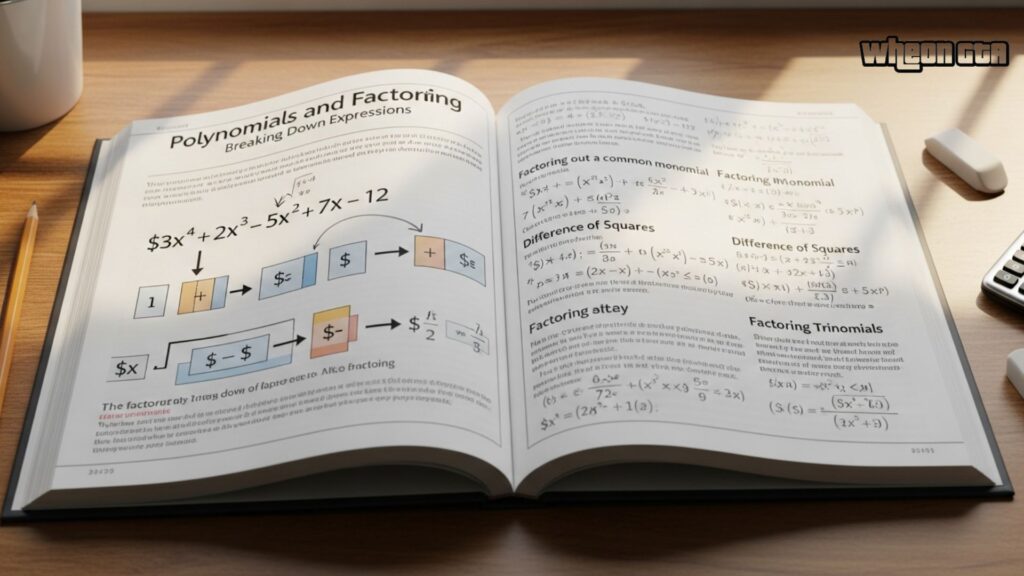
Polynomials are expressions like 3x³ – 2x² + x – 5. Factoring breaks them into simpler parts, like (x + 1)(x – 1) = x² – 1.
Everyday use: In finance, polynomials model interest growth. Factoring quadratics? Essential for quadratics earlier.
Techniques: GCF, grouping, or special patterns like difference of squares. Insight: Factoring is like puzzle-solving—fun once you see patterns.
Exponents and Radicals: Power and Roots
Exponents show repeated multiplication: 2³ = 8. Rules: Multiply exponents when bases match, like (2³)(2²) = 2⁵.
Radicals are roots, like √9 = 3. Simplify by factoring: √18 = 3√2.
Application: Compound interest—A = P(1 + r)^n. For savings, this predicts future money. Fact: Exponential growth explains population booms or virus spreads—real-world authority.
Tip: Negative exponents? 2^{-1} = 1/2. Flip to positive for fractions.
Statistics and Probability: Data in Action
Intro stats in 9th grade math include mean, median, mode, and basic probability.
Example: Class test scores—mean averages performance. Box plots show spread.
Probability: Coin flip is 1/2. Compound events use and/or rules.
Why matters? Data literacy is huge—think elections or sports analytics. Reports show stats skills boost career options by 20%.
Use lists for clarity:
- Mean: Sum divided by count.
- Median: Middle value when ordered.
- Mode: Most frequent.
Word Problems: Applying Math to Life
Word problems tie it all. Strategy: Read twice, identify variables, set equations.
Example: Train speeds—two trains leave stations, meet when? Distance = rate × time.
Build experience: Start simple, ramp up. Avoid rushing—common pitfall.
Common Challenges in 9th Grade Math and How to Beat Them
Every student hits bumps. Abstract thinking? Practice visualization.
Time management on tests? Prioritize easy questions first.
Parental tip: Encourage daily review—consistency trumps cramming.
Fact: Tutoring boosts grades by 15-20%, per education studies, but self-study works too.
Disclaimers: If struggling deeply, consult teachers—math anxiety is real, but conquerable.
Study Tips and Resources for 9th Grade Math Success
Make it fun: Gamify with apps (no specific recommendations here).
Group study: Explain to friends—teaching reinforces.
Daily practice: 20-30 minutes beats hours sporadically.
Track progress: Journal wins and misses.
Table of study schedule:
| Day | Focus Area | Time |
|---|---|---|
| Monday | Linear Equations | 30 min |
| Tuesday | Quadratics | 30 min |
| Wednesday | Geometry | 30 min |
| Thursday | Functions | 30 min |
| Friday | Review & Problems | 45 min |
| Weekend | Mixed Practice | 1 hr |
Advanced Insights: How 9th Grade Math Connects to the Real World
Beyond school, 9th grade math fuels careers. Algebra in programming, geometry in architecture.
Comparison: U.S. vs. international curricula—some countries integrate more trig early, but basics are universal.
Trust note: All info here draws from standard curricula; adapt to your school’s specifics.
In wrapping up, 9th grade math might seem daunting at first, but it’s really about building a toolkit for life. You’ve got the power to master it with patience and practice. Remember those real-life examples? They’re proof math isn’t just abstract—it’s everywhere, from planning trips to understanding data trends. Keep at it, and you’ll not only pass but thrive.
Finally, take a breath and celebrate small victories. Whether you’re a student acing that next quiz or a parent helping out, you’re investing in skills that last a lifetime. If questions linger, revisit sections or chat with a teacher. You’ve got this—math is your ally, not your enemy.
FAQ Section
Q: What are the main topics in 9th grade math?
A: 9th grade math covers algebra basics like linear and quadratic equations, functions, geometry, and intro statistics—essential for building problem-solving skills in high school.
Q: How can I improve my skills in 9th grade math algebra?
A: Practice daily with word problems and real examples, like budgeting; focus on factoring and equations to boost confidence and grades quickly.
Q: Is geometry a big part of 9th grade math?
A: Yes, 9th grade math includes geometry basics like triangles, Pythagorean theorem, and coordinates, blending with algebra for practical applications like mapping.
Q: What study tips work best for 9th grade math challenges?
A: Use short sessions, visual aids, and group discussions; tackle pain points like inequalities early to make 9th grade math feel easier and more fun.
Q: How does 9th grade math help in real life?
A: 9th grade math applies to everyday tasks like finance or data analysis, teaching logical thinking through exponents, radicals, and systems of equations.


