Russian School of Math Review: Is RSM Really Worth It for Kids?
The Russian School of Math is becoming very popular among parents who want their kids to learn math in a strong and confident way. Many families feel that normal school math is not enough, so they look for extra help that actually works. This is where the Russian School of Math, also called RSM, comes in. It uses a simple but powerful method that helps children understand math deeply instead of just memorizing it.
In this blog, we will talk about what the Russian School of Math is, how it works, why parents choose it, and how it helps kids learn better. We will keep everything in easy English, friendly tone, and step-by-step storytelling so every reader understands it clearly.
Let’s explore how the Russian School of Math helps kids grow, think, and solve math problems with confidence.
Read More : Unlocking Math in Spanish: Fun Ways for Kids to Learn Bilingual Numbers and Shapes
What Is the Russian School of Math?
The Russian School of Math is an after-school math program that teaches children using the Russian teaching style, which is known for being strong, logical, and very deep. In this method, kids don’t just “learn formulas.” Instead, they understand why math works, so they can solve problems easily.
RSM focuses on:
- Clear logic
- Step-by-step problem solving
- Understanding, not memorizing
- Building confidence
Parents choose RSM because they want their children to learn math in a way that stays with them forever, not just for tests.
Why Parents Choose the Russian School of Math
Many parents feel that regular school math is too fast or too basic. Kids often get confused because they do not learn the basics properly. The Russian School of Math helps children understand math at a deeper level.
Here’s why parents like it:
- Kids learn at a steady pace
- Concepts are explained visually
- Homework helps practice
- Teachers give personal attention
- Kids build strong logic and confidence
Parents say that their kids start enjoying math more than before because the lessons feel like solving puzzles instead of boring formulas.
How the Russian School of Math Teaching Method Works
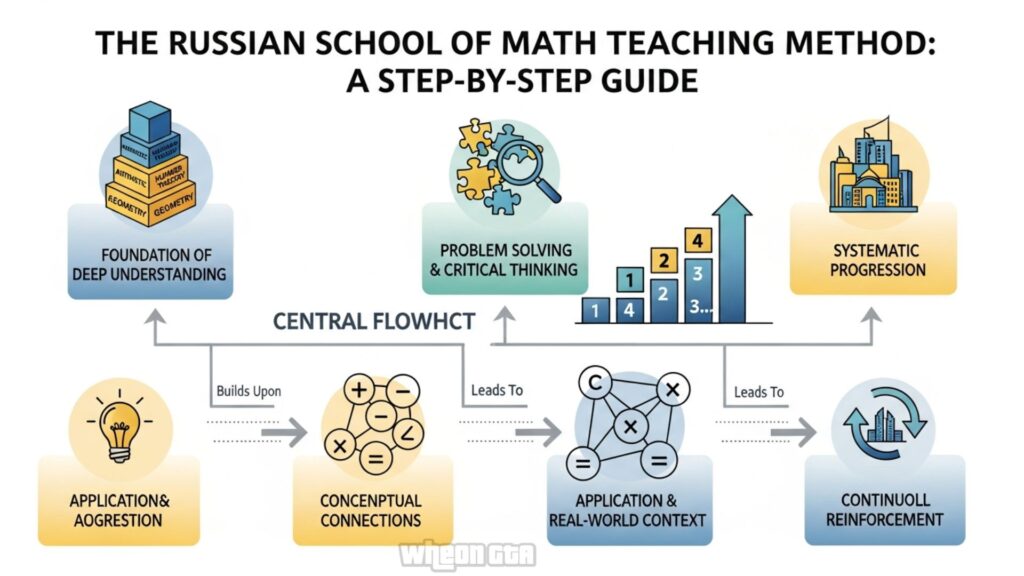
The RSM method is simple but powerful. They want children to “think in math,” not just “solve math.” Each lesson starts with a small example, then becomes a little harder. This helps the child grow step-by-step.
Here is how RSM teaches:
- The teacher shows the idea in simple words
- Kids solve problems together
- Examples become harder slowly
- Homework helps practice
- Each topic is revised again later
This method is great for kids who feel shy or scared of math. It slowly builds their confidence.
Benefits of the Russian School of Math for Kids
When children learn math with understanding, they stop fearing it. RSM focuses on building the mind like a muscle.
Here are the biggest benefits:
✔ Better Problem-Solving Skills
Kids learn to break problems into small steps.
✔ Strong Mental Math
They calculate faster in their heads.
✔ Deep Understanding of Concepts
No need for memorizing formulas.
✔ Improved School Grades
School math becomes easier.
✔ Long-Term Confidence
Kids feel proud when they solve tough questions.
Parents often say their children start using math in daily life too—counting, planning, and thinking logically.
Russian School of Math vs. Regular School Math
Below is a simple comparison:
| Feature | Russian School of Math | Regular School Math |
| Focus | Deep understanding | Passing tests |
| Style | Step-by-step logic | Memorizing formulas |
| Pace | Slow and careful | Fast and broad |
| Homework | Practice-based | Limited |
| Confidence | Builds slowly but strongly | Depends on school |
This table shows why many families choose RSM for extra support.
Who Should Join the Russian School of Math?
The Russian School of Math is great for:
- Kids who want to improve grades
- Kids who feel shy or scared of math
- Kids who want to learn ahead
- Kids preparing for math competitions
- Kids who want strong basics
Even children who already enjoy math can learn more advanced skills here.
What Subjects Does RSM Teach?
The program mainly focuses on:
Core Math Concepts
- Addition
- Subtraction
- Multiplication
- Division
- Fractions
- Geometry
- Algebra
- Word problems
Advanced Math Concepts
- High-level algebra
- Advanced geometry
- Logic puzzles
- Competition math
This helps kids feel ready for higher grades.
Are the Teachers in Russian School of Math Experienced?
Yes. Most teachers have years of experience and are trained to explain math in simple ways. They use examples like apples, boxes, shapes, and real-life stories to make math fun.
Kids feel safe asking questions because teachers encourage them to think without fear.
Online vs. In-Person Russian School of Math
Parents can choose between online and in-person classes.
Online RSM
- Best for busy families
- Kids attend from home
- Same high-quality teaching
In-Person RSM
- Face-to-face interaction
- Group learning
- More social experience
Both options follow the same teaching method.
Real-Life Examples of How RSM Helps Kids
Example 1: Learning Fractions
Instead of just saying “1/2 + 1/4,” teachers draw pizza slices to show how fractions combine.
Example 2: Word Problems
Teachers tell short stories so kids understand what the question is asking.
Example 3: Algebra Basics
Before teaching equations, they explain patterns using simple objects like dots or blocks.
These small steps help children understand everything easily.
Does the Russian School of Math Improve Grades?
Yes. Most parents notice that their children start scoring better in school because they understand math more clearly. When school teachers ask questions, RSM kids answer confidently because they already learned the basics deeply.
Some kids even jump from average to top position in class.
Common Complaints About the Russian School
No system is perfect. Here are common issues parents mention:
- Homework feels heavy
- Classes can be fast for some kids
- It takes time to adjust
- Some kids feel pressure at first
But many parents also say the results are worth it once the child settles in.
Is the Russian School of Math Worth the Money?
Yes, for most families. RSM is more than a tutoring center—it’s a long-term learning program. It helps children build logic and confidence that lasts for years.
Parents say they see improvements not only in math but in overall thinking and school performance.
Conclusion
The Russian School of Math is a strong and trusted program that helps kids learn math with deep understanding. Its teaching style is clear, step-by-step, and designed to build logic, confidence, and lifelong skills. Whether your child struggles in school or simply wants to grow stronger, RSM offers a solid foundation that supports every type of learner.
By focusing on understanding instead of memorizing, RSM makes math easier, friendlier, and more enjoyable. Parents who choose this program often see their kids become more confident, faster at problem-solving, and better prepared for future grades. If you want a method that truly builds strong math abilities, the Russian School of Math is a great option to explore.
FAQs
Q1: What is the Russian School of Math?
A: It is an after-school program that teaches math using deep, logical, step-by-step methods to help kids understand concepts instead of memorizing them.
Q2: Is the Russian School of Math good for beginners?
A: Yes, the program is designed to help both beginners and advanced students by building strong basics and confidence.
Q3: How does the Russian School of Math improve grades?
A: RSM teaches children to think clearly, understand concepts deeply, and solve problems with confidence, which leads to better school performance.
Q4: Does the Russian School of Math give too much homework?
A: RSM gives practice homework to help kids understand concepts better. It may feel heavy at first, but most students adjust over time.
Q5: Is the Russian School of Math worth it?
A: Yes, many parents see strong improvements in their child’s confidence, understanding, and long-term math skills.